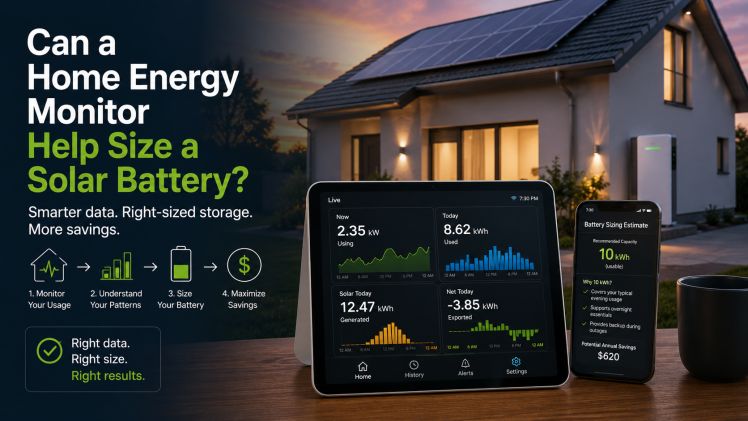
Battery sizing is where guesses get expensive. Too small, and the system cannot carry the loads that matter. Too large, and the homeowner pays for capacity that rarely gets used. A home energy monitor can make the sizing conversation less abstract by showing how the house actually uses power.
A kilowatt-hour, or kWh, is a unit of energy. A 1,000-watt load running for one hour uses 1 kWh. That simple definition becomes useful when a homeowner is trying to decide whether the battery should support only essentials, shift evening solar use, or back up larger portions of the house.
Start With the Job, Not the Battery
The first question is not “How many batteries?” It is “What should the battery do?” Backup power, solar self-consumption, and TOU savings all point to different sizing choices. A home that only needs refrigeration, Wi-Fi, lights, and a few outlets during an outage may not need the same capacity as a home trying to support HVAC and an EV charger.
The U.S. Department of Energy encourages households to understand appliance and electronics energy use before making efficiency decisions. The same habit helps with storage design. A monitor can show overnight baseload, evening peaks, and how often large loads overlap.
That load history is useful when comparing options such as a modular home battery system, where capacity can be planned around actual household behavior instead of a generic rule.
Solar Recharge Matters, But It Is Not Guaranteed
If the battery is paired with solar, daylight can extend backup runtime and improve daily value. But solar production changes with season, weather, shading, and roof orientation. NREL’s PVWatts tool estimates production using location and system details, while monitoring shows whether real-life use lines up with the estimate.
This is where homeowners sometimes overestimate storage. A battery may be large enough for a sunny spring outage but not for a stormy winter evening. A monitor that shows historical winter loads and solar output gives the installer a better starting point.
Leave Room for Future Loads
Battery sizing should also account for what the home may add later. A heat pump, electric water heater, induction range, or EV charger can change the load curve. If those upgrades are likely, the homeowner should ask whether the system can scale.
Sigenergy product materials list BAT 6.0 and BAT 9.0 LFP battery modules at 6.02 kWh and 9.04 kWh, with stackable capacity up to about 54 kWh per stack. That makes the SigenStor energy storage system relevant for homeowners who want a system that can grow beyond the first installation.
The monitor can also reveal whether the home has a high steady baseload or short bursts of demand. Those two patterns may require different design choices. A steady overnight load affects runtime hour after hour, while a short power spike may matter more for inverter output and load-control strategy than for total capacity.
A good installer can use that history to build a better proposal. Instead of asking the homeowner to remember every appliance, the conversation can start with actual curves: lowest overnight use, evening peak, largest start-up loads, and how often the home exports solar. That evidence makes it easier to size storage for the job rather than the sales package.
A home energy monitor will not choose the battery by itself, but it can keep the decision grounded in real use.