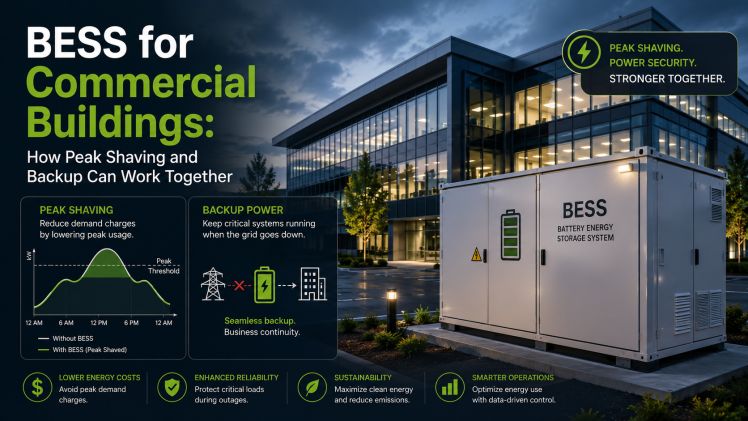
A commercial building can pay for one stressful afternoon all month. HVAC ramps up, refrigeration cycles, equipment starts, EV chargers draw power, and the utility records a new demand peak. Even if the building uses energy carefully most of the time, that short window can be expensive.
Battery storage gives facility teams a way to manage those peaks without shutting down operations.
Peak Shaving Without the Buzzwords
Peak shaving means discharging a battery when a building’s grid demand is about to hit a high point. Energy use is measured in kilowatt-hours, but demand is measured in kilowatts. Many commercial tariffs include demand charges based on the highest interval in a billing cycle.
A commercial BESS, or battery energy storage system, can lower that grid peak by supplying part of the load. The building still uses electricity, but it pulls less from the utility at the most expensive moment.
The National Renewable Energy Laboratory has identified demand-charge management as a key value stream for behind-the-meter storage. The catch is that the battery must predict peaks accurately. Discharging too early or too late can miss the savings.
Backup Is the Second Job
Backup power asks a different question: what must keep running when the grid fails? For a grocery store, it may be refrigeration and checkout. For an office, it may be servers, access control, and basic lighting. For a clinic, the list may be more sensitive.
Peak shaving and backup can conflict if the system is not managed. A battery that spends all its energy reducing demand may have too little reserve when an outage begins. A battery held full for backup may miss daily savings.
This is why control strategy matters. A commercial site may keep a backup reserve, increase that reserve before severe weather, and use the remaining capacity for peak management.
For these mixed-use cases, SigenStack commercial storage is relevant because modular BESS design lets facilities match storage capacity to load profiles, backup requirements, and expansion plans.
Solar and EV Charging Raise the Stakes
Commercial solar can reduce daytime energy purchases, but it may not erase demand charges. A site can still peak when clouds pass, equipment starts, or late-day cooling overlaps with other loads. Storage helps move solar value into the windows that affect bills.
EV charging adds another reason to plan ahead. Employee, customer, or fleet charging can create new peaks if chargers are not coordinated. A battery can buffer those loads and reduce the need for immediate utility service upgrades in some projects.
The International Energy Agency reported in 2024 that global battery additions to power systems reached 42 GW in the prior year. At the building level, that same storage growth is showing up as more facilities combine savings, resilience, and electrification planning.
Questions Before Procurement
Facility managers should ask which tariff line items the battery will address, which loads are backed up, how reserve settings are handled, and what data the monitoring system provides after installation. A proposal should also explain expansion options if the business adds EV charging or more solar later.
The gateway layer is especially important in larger commercial systems. A business energy gateway can help coordinate storage, solar, backup behavior, and multi-unit operation instead of leaving each component to act separately.
Commercial BESS works best when it is not treated as a battery purchase. It is an operating strategy. The building needs the right battery, but it also needs the right forecast, controls, backup priorities, and maintenance plan.